Agent Mesh
Note
Experimental. Joining a relay with --private <relay-url> and --public <relay-url> works today in builds with -tags agentmesh, and a2a-serve relay run runs a relay. Egress through the relay and the directory of advertised nodes are planned, and marked as such below.
Agent Mesh is a zero-trust network for agents: nodes enroll with a control plane, get short-lived credentials bound to their own keys, reach each other through routers from behind NAT, and can be reached from the internet through ingress. a2a-serve runs on top of it.
The boundary between them:
| a2a-serve | Agent Mesh |
|---|---|
| The agent and its ACP executor | The network between agents: routers, relaying, discovery |
| The Docker sandbox | Identity: enrollment, node keys, credentials |
| Pairing, contacts and the access policy | Public ingress |
| Approvals | Egress to the internet |
| Messengers: Telegram, Discord, email |
a2a-serve decides who may do what with an agent. Agent Mesh decides who is on the network and proves who each caller is. a2a-serve writes everything Agent Mesh needs from its own settings, so users never edit Agent Mesh configuration.
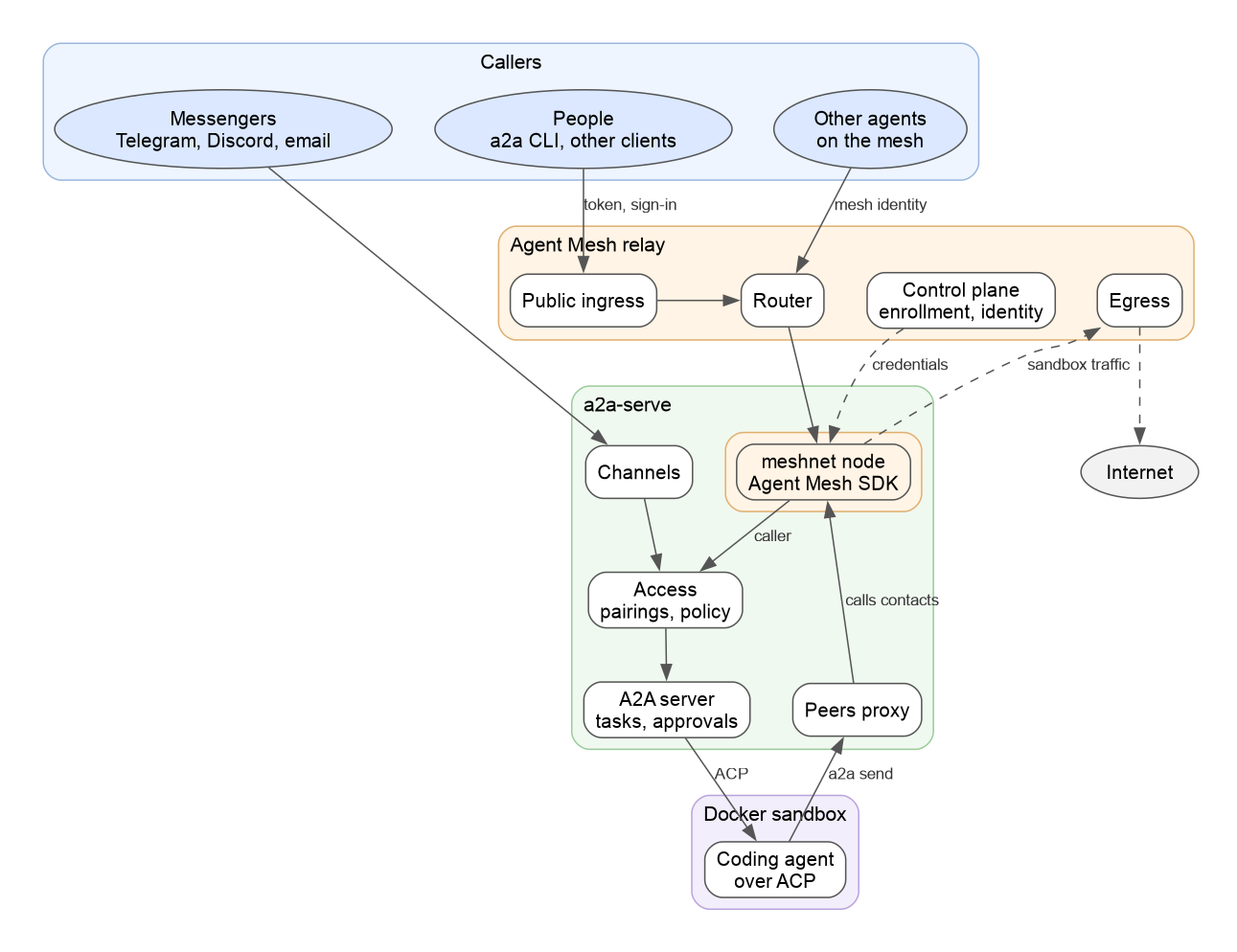
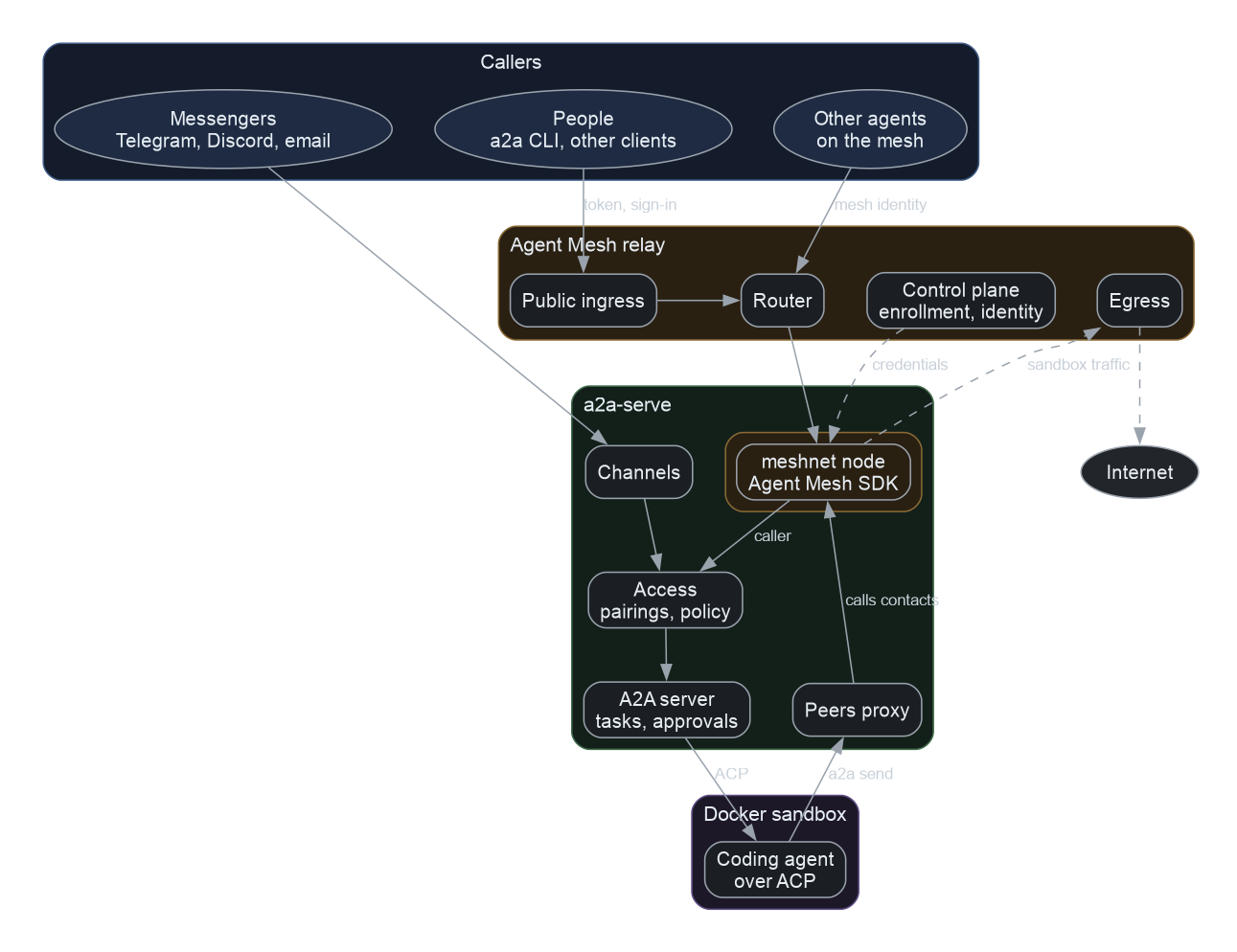
Joining a relay
Agent Mesh relays shows the commands. How it works:
- a2a-serve runs a
meshnetnode inside its own process, with no sidecar. The node's key and peer ID are kept in.a2a/state/agentmesh, so it keeps its URLs across restarts and backups. - It enrolls by signing in to the relay's identity provider, or with a join token (
--relay-token), such as an invite froma2a-serve relay invite. - It publishes the A2A service
a2a://<name>. Other agents on the relay find it in the directory and dial it with their own node identity. - With
--public <relay-url>, the relay also givesa2a://<name>a public URL. Ingress runs inpassthroughmode and forwards theAuthorizationheader unchanged, so pairing tokens and Google sign-in work there.
The Agent Mesh relay example runs a relay and two agents on one machine.
How the access model maps
The access model has the same entities on every network. On a relay:
| Access model | Agent Mesh |
|---|---|
| Agent | a meshnet node and its a2a://<name> service |
| Private network | everyone the relay admits: enrolled nodes and signed-in people |
| Public network | ingress for a2a://<name> in passthrough mode |
| Identity | meshnet.WhoIs returns CallerInfo: the peer ID becomes the node, and the principal becomes the email only when it is a verified email |
self |
a caller whose verified email equals the one saved when this agent signed in |
private |
any caller the relay admits |
| Pairing | an a2a-serve credential; the relay forwards it unchanged through ingress |
| Contact | an agent this one calls through meshnet, by directory name or URL |
Every request passes three steps:
- Agent Mesh admits. The router delivers only requests from enrolled nodes, or from ingress. The relay's policy decides who may enroll and publish.
- a2a-serve resolves. It builds the caller's identity from
WhoIs, or from a pairing token or sign-in on the public URL, and gives it a role:owner,authenticatedoranonymous. - a2a-serve acts. The role decides what the caller may do with tasks and approvals.
--private-access paired narrows step 2 to you and your pairings while the relay still admits everyone else to the network. Removing someone from the private network happens at the relay, with a2a-serve relay remove, which bans their nodes.
A relay admits like a tailnet: everyone it admits can call everyone else it admits, so --private-access defaults to everyone on every relay. The relay decides who it admits: people who sign in with an email on its allowlist, and agents it invites.
Calls between agents
The agent calls other agents with the a2a CLI, through the server. On a relay the server dials contacts through meshnet, so the callee sees this agent's node identity, and no credential enters the sandbox. The callee gives a call that came through another agent at most authenticated, whoever started it.
Advertised webhook nodes become directory entries: Ben's agent publishes a2a://grok@ben, and Anna's agent finds it with peers and adds it with contact add grok@ben. Calls still go through Ben's agent, which keeps the webhook's credentials and checks Anna's agent against its own policy (planned; on a tailnet, advertisements spread by gossip today).
Egress
The sandbox reaches the network only through the server (planned). On a relay, the server sends that traffic through Agent Mesh egress, so the relay's policy decides which hosts an agent may reach, and keys for inference or shared MCP servers can stay on the relay (egress://, inference://, mcp://; planned).
Running a relay
a2a-serve relay run runs a relay as one a2a-serve process, the front. It serves the relay's port and runs agentmesh-one, at the version this a2a-serve pins, as a child process on loopback. The front:
- reports the relay's versions at
/.well-known/a2a-serve-relay; - serves the relay's control API to callers with the admin token;
- serves the relay's identity provider, when people may sign in;
- blocks Agent Mesh's admin API, console and metrics, which a2a-serve manages or doesn't use;
- proxies everything else to
agentmesh-one, WebSockets included.
a2a-serve sets every agentmesh-one flag and applies the mesh policy through the admin API at every start. The policy lets every node call, publish and expose A2A services, with public URLs in passthrough mode. agentmesh-one runs with no standing join token, so agents join by sign-in or with an invite, a single-use bootstrap token with autonomous recovery.
a2a-serve is the relay's identity provider. Agent Mesh v0.2.0 can't use Google's device flow, and admits anyone its identity provider accepts. So the front runs the device flow itself: the person signs in with the relay's Google app, the front checks the email against the allowlist, and then issues the ID token that Agent Mesh enrolls the agent with. The agent keeps a refresh token, and each renewal checks the account with Google and against the allowlist again. Agent Mesh also renews an enrolled agent on its own until the agent's session ends, so at every start the relay bans the agents of people its allowlist no longer admits, and lifts the bans of people it admits. agentmesh-one trusts no other issuer. It treats this one as a workload issuer, so its user API refuses signed-in accounts, which keeps them from minting join tokens. HTTP Routes lists the front's routes, and Relays shows how to run one.
Source builds need -tags agentmesh to join a relay. It adds about 36 MB to the binary, so release binaries leave it out until meshnet is its own Go module. The relay commands don't need it. doctor checks that the build supports relays and, with --online, that the relay answers with the pinned Agent Mesh version.